
GTM Journal - Before you change the tools
ed.png)

The minute outbound comes up, someone asks about tools. Apollo? Clay? HeyReach? Claude?
Fair question. But it usually comes too early.
I’ve always been against spray and pray. Unless your total addressable market is everyone and their mother, you have to be careful. Your ideal prospects are finite. Especially in the short run. When we run LinkedIn outbound for clients, we’re working with 100–120 connection requests and 20–30 messages to start. That’s it. So every name on that list has to count.
Which is why when outbound underperforms, the issue is rarely the stack.
It’s usually something simpler:
- Wrong accounts
- Weak timing
- No signal
- Messaging that gives people no reason to reply
and sometimes it’s deeper, like:
- positioning is wrong
- no PMF
- no trust signals
Run this diagnostic before you change anything:
That’s usually where the real issue sits.
- Sent 50+ messages, reply rate under 5%? Fix the message, not the list.
- Hearing the same objection repeatedly? That’s a positioning problem, not a sales problem.
- Sent 100+ messages, zero leads? Test a different ICP or a different channel.
- Replies coming in but no meetings? The CTA is probably too big.

What actually makes or breaks outbound
Tools help execute. But the work that determines whether outbound converts happens before anyone sends a message.
Here’s the order that matters:
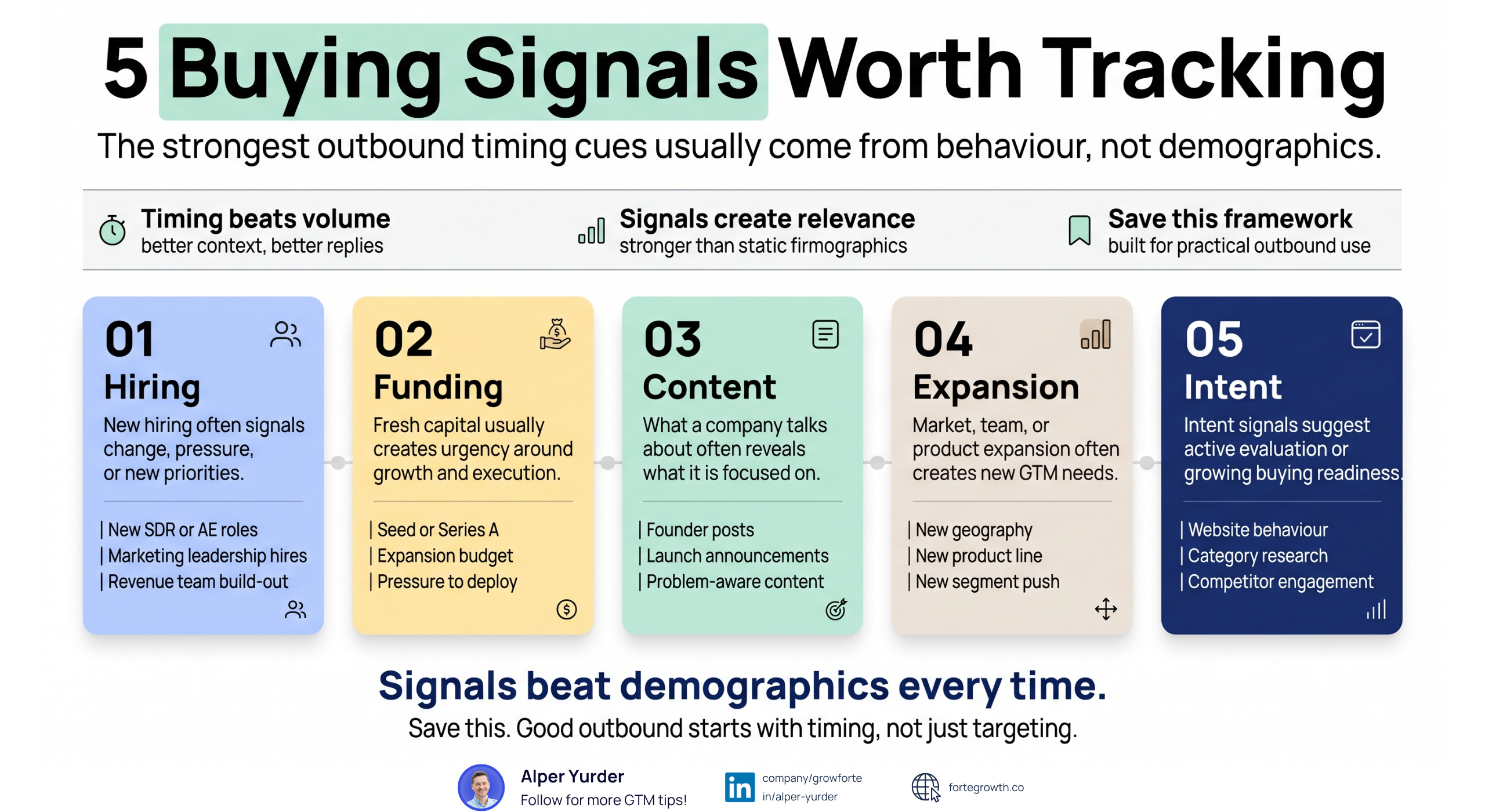
1. Targeting. Not by demographics. By behaviour.
The teams converting at 10–30% reply rates don’t filter by title and headcount. They track signals:
- Hiring for the role your product replaces
- Recently raised, new budget pressure
- Posting about the problem you solve
- Entering a new market or geography
- Visiting competitor sites, reviewing on G2
Demographics tell you who exists. Signals tell you who’s ready.
2. Persona depth.
Getting the ICP right on paper isn’t enough. You need to understand what they care about, what they’re Googling at 11pm, what their trigger events look like, what they want to be educated on. We re-listen to customer calls specifically for this. The brief tells you what to say. Deep persona work tells you how to say it so it actually lands.
3. The trust layer. And this is the one most teams skip entirely.
Even with the right account, at the right moment, with a relevant message - if they don’t know you, conversion stalls. The reply rate is fine. But the meeting rate is low. Because a cold message from a stranger, however well-targeted, still carries friction.
This is why I keep saying: inbound is the best outbound.
When someone has already seen you solve problems like theirs - through a LinkedIn post, a piece of content, a point of view - the cold email isn’t cold anymore. Your SDRs are starting conversations, not interrupting strangers.
At Witco, we ran 200+ enterprise conversations this way. Not spray-and-pray. Content warmed the market first. Reply rates on the back of that were 15–30%, not 1–2%. Same effort. Completely different outcome.
The stack itself is fairly simple
- Apollo, LinkedIn Sales Navigator, and Ocean.io for prospect discovery
- Clay and Trigify for enrichment and signal detection
- Claude, GPT, and Gemini for research and scoring
- LinkedIn, HubSpot, and HeyReach for execution
Nothing especially clever there. What matters is what the system is built on top of.
The data backs this up. Salesforce found sales teams now use an average of 8 tools, while 42% of reps feel overwhelmed by too many of them - overwhelmed reps are 45% less likely to hit quota. LinkedIn found 78% of B2B buyers strongly agree outreach should be personalised. 6sense found buyers are already 69% through their purchase process before engaging with sellers.
So by the time they hear from you, they’ve often already formed a view. The question is whether that view includes you.

The real system
Done well, outbound isn’t a standalone motion. It sharpens your messaging. It exposes where positioning is weak. It tells you what your website needs to say. It gives the founder better angles to speak from.
The breakthrough is rarely another tool. It’s usually:
- A tighter ICP
- Better signal triggers
- Stronger positioning
- A trust layer built before the conversation starts
- And founder-led conversations that actually feel relevant

If this is useful
If you want a clearer view of what’s actually slowing your GTM down, start here.
👉Book a 30-minute advisory call - I’ll diagnose your growth bottlenecks across 6 key pillars from GTM essentials to outbound and marketing activities that build trust, authority and credibility.
Not ready to talk yet? Start with the free resources:
- GTM Diagnostic - 10 minutes to benchmark where you stand
- Outbound Diagnostics Guide - the foundational diagnostic playbook
- From Early Traction to £1M ARR - the full 20-step system
- All playbooks - everything in one place
- Case studies - see the results before you commit
Ready to move forward
Talk to us about your GTM challenge and we'll recommend the right fit.